
What Is an Annual Maintenance Contract (AMC)? Meaning, Types & How It Works
What Is an Annual Maintenance Contract (AMC)?
An annual maintenance contract (AMC) is a yearly service agreement in which a customer pays a fixed fee upfront, and the provider commits — for one year — to deliver a defined set of maintenance services: typically scheduled inspections, preventive servicing, and priority support for a device, vehicle, or piece of equipment. Instead of paying for each visit separately, the customer prepays for a bundle of coverage, and the provider works to a schedule instead of waiting for a breakdown call.
That one line is the AMC meaning in full — everything else below is detail about scope, type, and price.
AMCs show up across very different industries — IT hardware, industrial machinery, building facilities, home appliances, and vehicles — but the structure stays the same: a fixed annual fee, a defined scope of covered work, and a renewal date twelve months out. For repair and service businesses specifically, an AMC is the mechanism that turns a one-time repair job into a year of scheduled, budgeted work.
AMC vs Warranty vs Comprehensive Maintenance Contract (CMC)
These three terms get used interchangeably, and that’s where most confusion about an annual maintenance contract starts.
A warranty is free, comes bundled with the purchase of a device or vehicle, and covers manufacturing defects only — not routine wear, accidental damage, or scheduled servicing. It expires on a fixed date regardless of usage and is provided by the manufacturer, not the shop that sells or services the item.
An AMC is a paid contract, signed separately from the purchase (or once the warranty ends), and it covers scheduled maintenance visits plus, in most agreements, discounted labour on unscheduled repairs. A standard AMC agreement usually covers labour only — parts used during a covered visit are billed separately.
A comprehensive maintenance contract (CMC) is the “all-inclusive” version of an AMC: it covers both labour and parts (or spares) under the same annual fee, which is why a CMC costs more than a standard AMC for the same equipment.
| Warranty | Annual Maintenance Contract (AMC) | Comprehensive Maintenance Contract (CMC) |
|---|---|---|
| Free, bundled with purchase | Paid, sold separately | Paid, usually priced above a standard AMC |
| Covers manufacturing defects only | Covers scheduled maintenance + labour on repairs | Covers scheduled maintenance + labour + parts |
| Fixed term set by the manufacturer | Typically a 12-month term, renewable | Typically a 12-month term, renewable |
| Provided by the manufacturer | Provided by the manufacturer, dealer, or repair shop | Provided by the manufacturer, dealer, or repair shop |
| No scheduled visits | Includes scheduled preventive visits | Includes scheduled preventive visits |
Common Types of Annual Maintenance Contracts
An AMC contract isn’t one product — it changes shape depending on what it’s covering.
- Equipment / IT AMC: servers, computers, printers, and networking equipment covered by the manufacturer or an IT services company; usually includes a fixed number of on-site visits, firmware and software updates, and priority ticket handling.
- Facility Management AMC: elevators, generators, HVAC, and building systems covered by a facility contractor; combines routine inspection with an emergency callout SLA.
- Repair-Shop AMC: a computer, mobile, electronics, appliance, or auto repair business sells an AMC directly to the device or vehicle owner, bundling periodic cleaning and inspection, priority repair slots, and — in a CMC-style agreement — discounted or included parts.
For repair shops, the third type is the one that matters most: it’s a direct, repeatable revenue relationship with a customer who has already trusted you with one repair.
What an Annual Maintenance Contract Agreement Typically Includes
A well-drafted AMC agreement spells out five things, regardless of industry:
- Scope: exactly which services are included (cleaning, diagnostics, software updates, minor part replacement) versus what’s billed separately.
- Term: the contract length, almost always 12 months, starting from the signing or activation date.
- Response time: the turnaround the provider commits to for an unscheduled breakdown reported under the contract.
- Exclusions: physical damage, liquid damage, unauthorized repairs, and anything outside normal wear and tear.
- Renewal terms: the renewal price, notice period, and what happens if the covered device or vehicle is replaced mid-contract.
Spelling these out up front is what separates a real AMC agreement from an informal “we’ll take care of you” promise — and it gives whoever performs the service a clear checklist to follow on every visit.
Before you sign — or sell — an AMC, check these six things:
How AMC Billing and Renewal Work
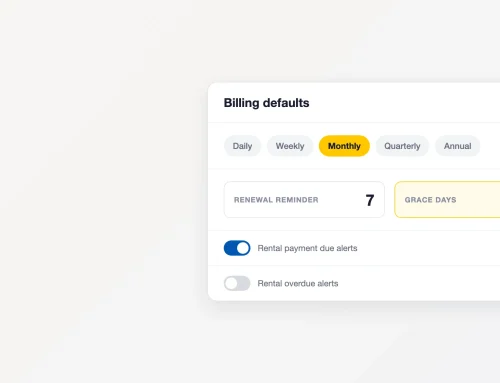
An AMC is billed as a single annual fee for the full 12-month term, paid upfront or, with some providers, in installments. Most providers offer two or three tiers — basic, standard, and premium — priced according to how much is covered, so a customer can pick the level of coverage that fits their needs.
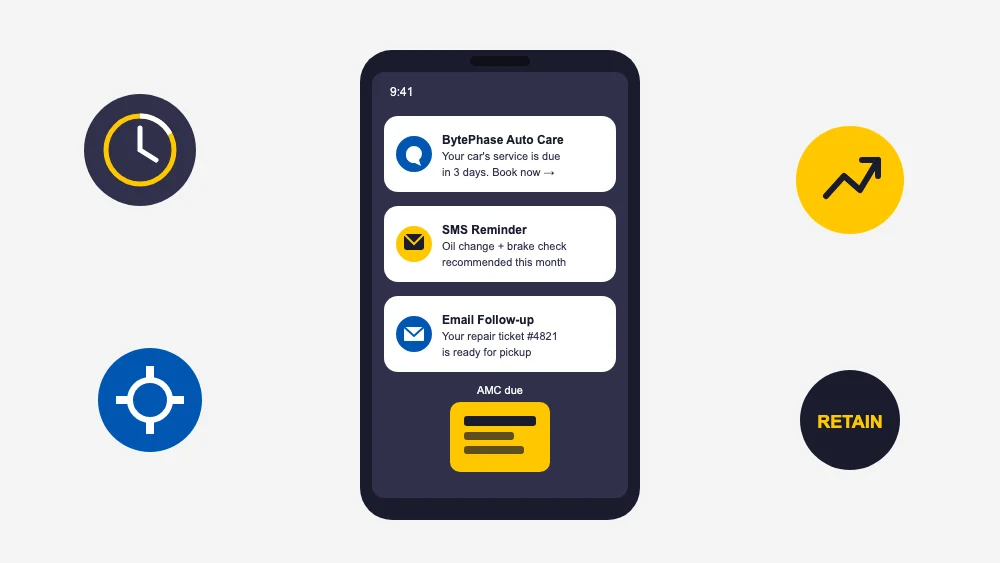
The AMC contract runs for a fixed term and then comes up for renewal. Some providers auto-renew unless the customer cancels; others require an active renewal decision before the term lapses. Either way, the practical risk is the same: if nobody is tracking renewal dates, coverage quietly expires, and the customer finds out only when something breaks and they’re billed full price for a repair they assumed was covered.
That’s why the businesses that manage AMC contracts well are the ones that send a renewal reminder before the expiry date, not after.
Why Repair Businesses Sell AMCs
For a repair or service business, an annual maintenance contract does something a one-off repair job can’t: it converts a single transaction into a year of scheduled, recurring revenue.
- Predictable revenue: an AMC book of business is income you can forecast, instead of income you have to go find every month.
- Customer retention: a customer on an AMC has a reason to come back to you specifically, instead of shopping around for their next repair.
- Fewer emergency repairs: preventive visits catch small issues before they become the kind of breakdown that costs more to fix and frustrates the customer more.
- Higher lifetime value: an AMC customer typically spends more with a shop over a year than someone who only shows up when something breaks.
This isn’t limited to computer or electronics repair — auto repair shops sell the same kind of contract to fleet customers and repeat vehicle owners, bundling oil changes, tire rotations, and inspections into one annual agreement instead of billing each visit separately.
How Software Manages an Annual Maintenance Contract
Tracking AMCs on a spreadsheet works for a handful of contracts. Past that, renewal dates get missed, nobody remembers which visit is due on which device, and a customer’s service history ends up scattered across old invoices instead of living on one record.
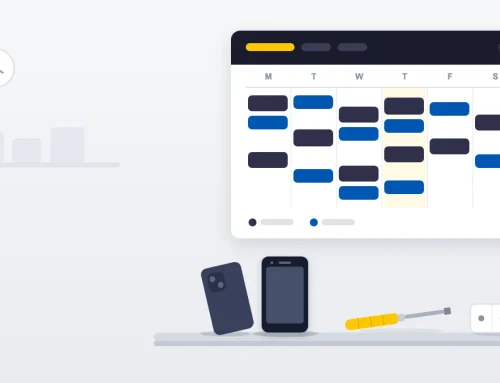
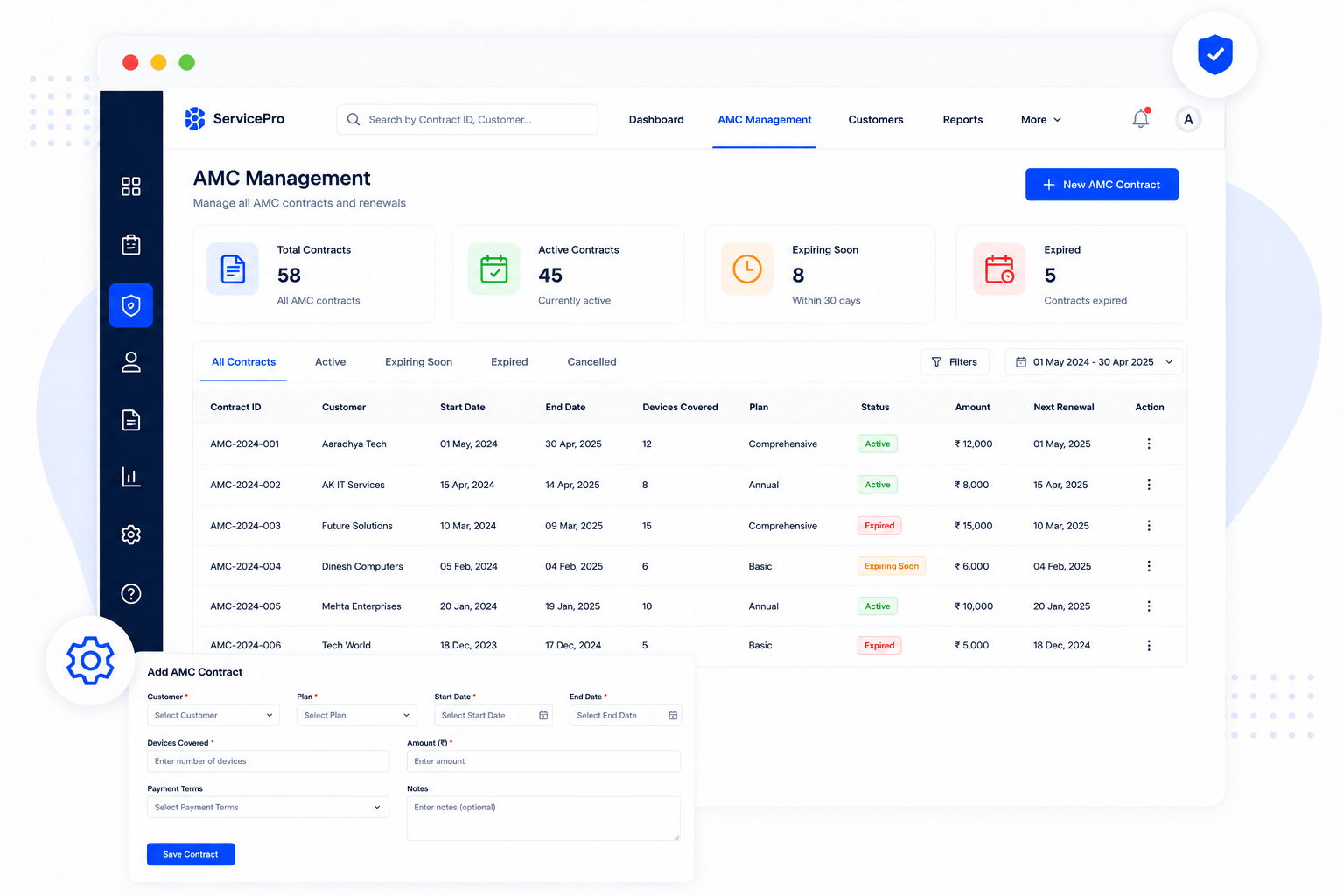
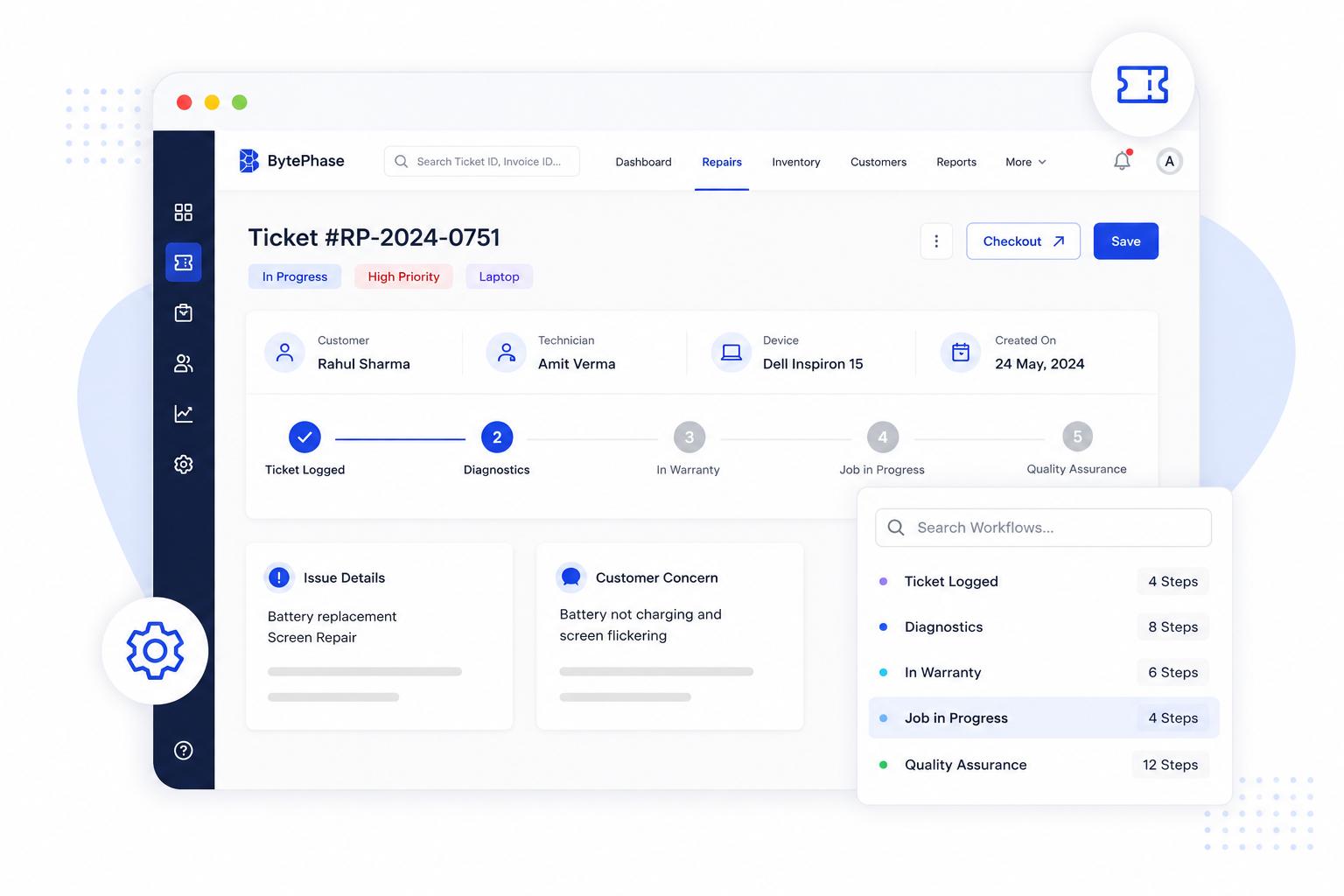
Purpose-built AMC management software fixes this by treating the contract as its own record instead of a side note on an invoice. In BytePhase, the AMC module schedules recurring services against a date or a usage trigger for each contract, then auto-generates the repair ticket the moment a covered service falls due — nothing depends on someone remembering to check a calendar. Renewal reminders go out automatically before a contract expires, and every contract’s value, term, and full service history sit on one customer record instead of scattered across old invoices. Updates — a scheduled visit confirmed, a ticket created, a renewal coming up — go out to the customer automatically over WhatsApp, SMS, or email.
This runs on the same repair ticket management software used for one-off jobs, so an AMC visit and a walk-in repair show up in the same workflow instead of two separate systems. It’s part of why BytePhase is used by 2,000+ repair businesses in 32+ countries — and it’s available on a 15-day free trial if you want to see how AMC management software handles a real contract book.
Annual Maintenance Contract FAQs
What is the full form of AMC?
AMC stands for Annual Maintenance Contract — a yearly service agreement in which a customer pays a fixed fee for scheduled maintenance and, in most agreements, priority repair support on a device, vehicle, or piece of equipment.
Is an annual maintenance contract worth it?
It depends on the value of the equipment, how heavily it’s used, and how likely it is to need service during the year. An AMC is worth it when the cost of the contract is lower than the likely cost of the repairs and downtime it prevents — usually true for equipment that sees daily use or that’s expensive to fix on a per-visit basis. It’s worth less for equipment that’s rarely used or unlikely to need service at all.
What is the difference between AMC and warranty?
A warranty is free, comes with the purchase, and covers only manufacturing defects for a fixed period. An annual maintenance contract is paid separately, covers scheduled maintenance and, in most agreements, discounted repair labour, and runs on its own renewable 12-month term.