
Cell Phone Repair Business Goals for 2026: A Practical Guide

Why Cell Phone Repair Business Goals Matter in 2026
Setting deliberate cell phone repair business goals is what separates a shop that grows on purpose from one that just stays busy. A general phone repair counter is not a single-brand operation the way a dedicated Android or iPhone specialist can be — on a given day you might be replacing an iPhone screen, swapping a Samsung battery, running data recovery on a water-damaged budget Android, and processing an insurance claim on a cracked tablet. That breadth is good for revenue, but only if your 2026 goals are built around the whole shop — intake, customer experience, and cash flow — not just the repair bench. This guide walks through assessing where your shop stands today, setting SMART targets that fit a multi-brand, multi-channel repair business, and tracking progress with real numbers instead of gut feel.
Assess Your Cell Phone Repair Shop’s Current Position
Before you set goals, get an honest read on where the business stands today. This is the same SWOT-style exercise any small business should run, applied to a repair counter:
- Financials: What’s your monthly revenue, average repair ticket value, and profit margin after parts and labor?
- Repair mix: What share of jobs are screens, batteries, charging ports, water damage, and software issues — and which categories actually make money once you account for part cost and rework?
- Customer base: Are most customers walk-ins, repeat customers, or referrals from insurance and carrier programs? Where are they finding you?
- Intake channels: Do customers only walk in, or can they book online, drop off a device for mail-in repair, or come through a warranty/insurance referral? Each channel has a different turnaround expectation.
- Competition: Who else in your area repairs phones, and are they cheaper, faster, or just more visible online?
- Operational efficiency: How long does an average repair actually take from intake to pickup, and how much of that is the phone sitting untouched?
A clear-eyed look at these numbers is the baseline every cell phone repair business goal in this guide should be measured against.
Set SMART Cell Phone Repair Business Goals for 2026
SMART goals are specific, measurable, achievable, relevant, and time-bound. Applied to a phone repair shop, that looks like:
- Specific: Not “get faster,” but “cut average same-day screen-repair turnaround from 3 hours to under 90 minutes.”
- Measurable: Track it with numbers you already have — repair turnaround time, average ticket value, first-time-fix rate, or Google review count.
- Achievable: A goal to reduce turnaround is realistic if you already stock your top-selling screens and batteries; promising the same for every rare model on the first attempt usually isn’t.
- Relevant: Tie the goal to what actually grows the business — if warranty claims are a growing share of revenue, a goal around claim turnaround matters more than a vanity social-media metric.
- Time-bound: “Increase repeat-customer rate by 15% in the next two quarters” creates urgency that “get more repeat customers” never will.
Diversify Your Goals Across These Areas
A well-rounded set of cell phone repair business goals covers more than just repair speed. Spread your targets across:
- Financial goals: Revenue targets, profit margin per repair category, and reducing dead stock through tighter parts ordering.
- Operational goals: Turnaround time, first-time-fix rate, and reducing the callbacks that eat into technician time.
- Customer experience goals: Make it just as easy for a customer to book online or mail in a device as it is to walk in — and keep them updated automatically once it’s checked in, instead of making them call to ask.
- Warranty and insurance claims goals: If you take carrier or insurance referrals, set a goal around claim documentation and turnaround — slow or incomplete paperwork is a common reason shops lose that channel.
- Marketing and local reputation goals: A phone repair shop lives or dies on local search and reviews. A realistic 2026 goal is a specific target for new Google reviews per month, not just “get more customers.”
- Revenue diversification goals: Cases, screen protectors, trade-in/buyback, and data recovery add margin beyond the repair itself — set a goal for what share of tickets include an add-on sale.
Prioritize and Sequence Your Goals
Not every goal deserves equal attention in the first quarter. Prioritize by asking:
- Importance: Which goal moves revenue or customer retention the most?
- Urgency: Is a slow warranty-claims process actively losing you that channel right now?
- Dependencies: You generally can’t hit a turnaround-time goal until your parts and intake process are already tracked cleanly.
- Resources: How much staff time and budget can you actually put behind a goal this quarter?
Start with the goal that has the clearest dependency chain, break it into monthly milestones, and schedule time to work on it rather than treating it as a background hope.
Review and Adjust Goals Regularly
Set a recurring review — monthly is realistic for a small shop — and check:
- Is the goal still realistic given what you’re seeing in the shop this quarter?
- Has anything changed — a new competitor, a part shortage, a shift in your repair mix — that should change the target?
- What’s actually blocking progress: staffing, parts availability, or the process itself?
Get input from your technicians and front-counter staff — they see the bottlenecks first — and be willing to revise a goal instead of quietly abandoning it.
Track Your Cell Phone Repair Business Goals With the Right Tools
Goals you can’t measure are just wishes. Purpose-built cell phone repair software gives a general repair shop the numbers this guide keeps coming back to:
- Log every intake channel in one place. Whether a device comes from a walk-in, an online booking, or a mail-in insurance referral, repair ticket management that captures brand, model, and reported fault at intake gives you a real read on your repair mix — the same data the assessment section above depends on.
- Track warranty and insurance jobs separately. Tagging claim-related tickets makes it obvious when documentation or turnaround is slipping.
- Measure technician performance and turnaround by repair type. If faster screen repairs is a 2026 goal, you need per-technician, per-category data, not a guess.
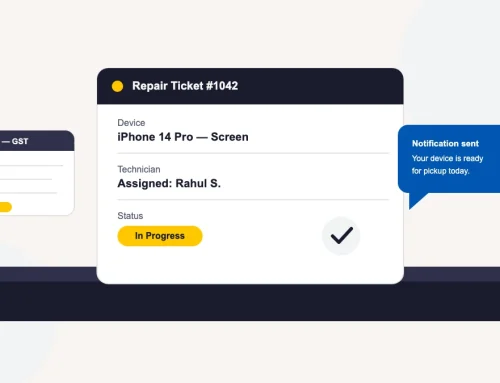
- Automate customer updates. SMS and WhatsApp status updates with OTP-verified delivery cut down “is it ready yet?” calls, freeing counter time for the goals themselves.
None of this replaces the planning work above — it just makes sure you can actually see whether you’re hitting the cell phone repair business goals you set.
Conclusion
In a shop that touches every brand and every intake channel, clear cell phone repair business goals are what turn a busy year into a profitable one. Assess where you stand, set SMART targets across finance, operations, customer experience, warranty claims, marketing, and revenue diversification, prioritize and sequence them, and review often — that combination is what drives real growth in 2026.
BytePhase helps you act on these goals, not just set them
BytePhase is trusted by 2,000+ repair businesses across 32+ countries to run repair tickets, device and warranty tracking, spare-parts inventory, invoicing, and automated customer updates from one dashboard — on web and native Android and iOS apps. Start your 15-day free trial and see how much easier it is to hit your 2026 goals with the right system behind you.