
How to Start a Phone Repair Business in 2026: Step-by-Step Guide
How do you start a phone repair business? Pick a focused niche (screen and battery repairs are the fastest entry point), write a lean business plan that budgets realistically for tools, parts, and software, then register the business and check your state and local licensing rules before you open. From there, choose the lowest-risk format your budget allows — home-based or mail-in before a full storefront — price your repairs to cover parts, labor, and overhead, and run the shop on repair-management software from day one so tickets, inventory, and customer updates never depend on memory or spreadsheets.
The sections below walk through exactly how to start a phone repair business, step by step, with realistic U.S. cost ranges and the questions most first-time owners ask.
Research the Market and Choose Your Repair Niche
Before you spend a dollar on tools or a lease, spend a week understanding who you’d be competing with and who you’d be repairing phones for. Search “phone repair near me” in your town and note how many shops show up, what they charge for a common job like an iPhone screen replacement, and how they’re reviewed. Zero independent shops usually means low demand, not easy pickings — check whether people are simply driving to the next town over instead.
Most successful independent repair businesses don’t try to fix everything for everyone on day one. They pick a niche and get very good at it before expanding:
- Screen and battery replacement — the highest-volume, most predictable repair category, and the easiest to learn first.
- Water and liquid damage recovery — higher skill and higher price point, fewer competent competitors.
- Board-level and micro-soldering repairs — the most technical tier (charging IC, backlight, logic-board faults), commands premium pricing, and is where “no fix, no fee” shops separate themselves from mall kiosks.
- Data recovery — often bundled with board repair, valued highly by customers who’d otherwise lose photos or contacts.
- Buy-back and trade-in — buying broken or used devices, refurbishing, and reselling; needs more working capital and, in many states, a secondhand-dealer license.
- B2B and small-business device fleets — servicing the phones and tablets a local business issues to staff, trading lower per-ticket margin for recurring, predictable volume.
Decide which one or two of these will be your core offer before you write a business plan — the tool list, parts inventory, and pricing model all flow from that choice.
Write Your Phone Repair Business Plan
A phone repair shop doesn’t need a 40-page investor-grade business plan, but it does need the standard sections written down, even if you’re self-funding:
- Executive summary — the one-paragraph version of what you repair, for whom, and where.
- Market analysis — the local competitor scan from the section above, plus who your ideal customer is (walk-in consumer, small business, or both).
- Services and pricing — your niche, your price list, and any add-ons (screen protectors, cases, data transfer, buy-back).
- Operations plan — hours, location format, supplier relationships, and the software you’ll run tickets through.
- Financial plan — startup costs, a break-even estimate, and a simple 12-month cash-flow projection.
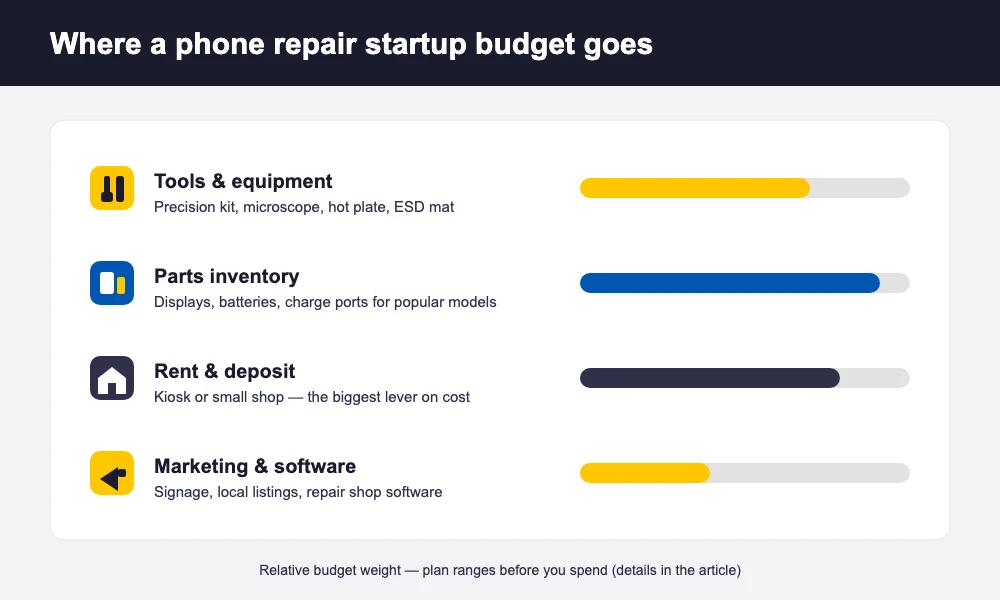
The financial plan lives or dies on realistic startup numbers. The table below gives industry-typical U.S. ranges — treat them as planning estimates to adjust to your city and format, not a quote:
| Startup cost category | Industry-typical U.S. estimate* |
|---|---|
| Business registration & licenses | $50 – $500 |
| Repair tools & equipment | $300 – $2,000 |
| Initial parts inventory | $1,000 – $5,000 |
| Repair-management software | roughly $20 – $100 / month |
| Home/mail-in workspace setup | $200 – $1,000 |
| Storefront lease deposit & buildout | $5,000 – $30,000+ |
| Signage & basic marketing | $200 – $1,500 |
| Business insurance (annual) | $300 – $1,200 |
| Working capital buffer (2–3 months) | $2,000 – $10,000 |
*Estimates only, based on typical U.S. independent repair-business ranges — actual costs vary by city, format, and supplier. Not a quote.
A home-based or mail-in start can realistically land at the low end of these ranges; a storefront with a lease and buildout pushes toward the high end. Either way, keep a cash buffer — the first three months are almost always slower than owners expect.
Register Your Business and Get Licensed
Once the plan is on paper, make the business official. In broad strokes, most U.S. phone repair businesses go through:
- Choosing a legal structure — many repair shops start as a single-member LLC for liability protection; a sole proprietorship is simpler for testing the idea part-time.
- Registering the business name with your state, filing a DBA if you’re trading under a name other than your own, and getting a free EIN from the IRS to open a business bank account.
- Checking city and county requirements — a general business license is close to universal; some cities add an electronics-repair or secondhand-dealer permit if you buy, sell, or trade used devices.
- Sales tax registration — most states require you to collect tax on repairs and parts, though some treat labor differently, so check your state’s rule.
- Business insurance — general liability at minimum, plus coverage for customer devices left in your care.
Requirements genuinely vary by state and city, so don’t rely on a generic checklist alone — the U.S. Small Business Administration’s 10 steps to start your business guide is a solid, authoritative starting point for confirming exactly what applies to you before you open.
Build Your Repair Skills and Get Trained
Technical skill is what customers are actually paying for, so don’t skip this step even if you’re confident with a screwdriver. At minimum you’ll want to be comfortable with:
- Screen, battery, and charging-port replacement across the popular iPhone and Android models in your market.
- Basic diagnostics — telling a battery problem from a charging-port problem from a logic-board problem before you quote a price.
- Soldering fundamentals, and eventually micro-soldering if you want to take on board-level work, which commands the best margins.
- Handling water-damaged devices without causing further corrosion damage.
You don’t need a four-year degree to get there. Manufacturer and third-party certification courses, paid micro-soldering bootcamps, YouTube channels run by working technicians, and a short apprenticeship at an existing shop are all realistic paths. Buy a few cheap, broken devices from marketplaces to practice on before you touch a paying customer’s phone — every experienced tech keeps a shelf of “practice” units.
Tools, Parts, and Suppliers
A capable repair bench doesn’t require an enormous upfront spend, but a few tools are genuinely not optional:
- A precision screwdriver kit with the odd-shaped bits (pentalobe, tri-point) modern phones use.
- A hot-air rework station or heat gun for adhesive and screen removal.
- Suction cups and plastic prying tools to open sealed devices without cracking the frame.
- An anti-static mat and ESD wrist strap to protect logic boards.
- A digital multimeter for diagnostics, and — once you move into board-level work — a microscope and micro-soldering iron.
Parts sourcing matters as much as tools. You’ll generally choose between OEM (original manufacturer) parts, high-grade aftermarket parts, and refurbished parts pulled from donor devices — each a different cost and quality tradeoff worth explaining to customers upfront. Work with a small number of vetted wholesale distributors rather than the cheapest listing you can find; a bad batch of screens or batteries costs far more in return visits than it saved on the invoice. Track the mix properly, too — a shop juggling several device brands and part grades in spreadsheets or memory will eventually oversell a part it doesn’t have. Barcode-based inventory management that ties parts directly to repair tickets is worth setting up before the shelf gets crowded, not after.
Choose Your Location: Storefront, Mail-In, or Home-Based
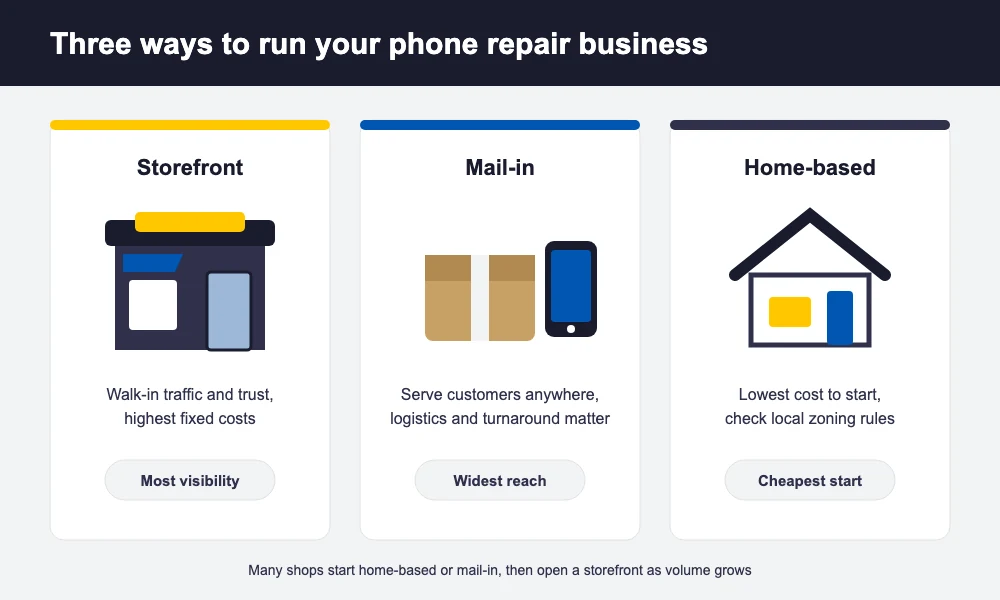
Where you operate is as much a financial decision as a strategic one, and it doesn’t have to be permanent.
- Storefront — the most visible option and the easiest for walk-in customers to trust, but it carries the highest fixed cost: lease, buildout, signage, and utilities every month regardless of ticket volume. Best once you have proven repair volume and local reputation to justify the overhead.
- Mail-in — customers ship devices to you; you repair and ship back. Lowest overhead, and it opens up a national customer base instead of just your zip code, but shipping damage and trust (an expensive device mailed sight-unseen) need to be managed deliberately.
- Home-based — the lowest-cost way to start, ideal for testing a niche or building a customer base by referral before committing to rent. Check local zoning rules for home businesses and any restriction on customer visits first.
Many repair businesses move through these in sequence — starting home-based or mail-in to prove the model, then opening a storefront once volume and cash flow justify the fixed cost.
Price Your Repair Services
Pricing is where a lot of new repair businesses either scare off customers or quietly lose money on every ticket. A dependable starting formula is cost-plus: parts cost, plus your labor time at a real hourly rate, plus a share of overhead (rent, software, insurance), plus a margin — then check that number against what the two or three shops you scouted earlier are charging for the same repair. You don’t have to be the cheapest option in town; you have to be priced clearly and confidently enough that customers understand what they’re getting.
A few pricing habits that hold up over time:
- Quote a firm price (or a tight range) before you start work, not an estimate that creeps once the device is open.
- Price board-level and water-damage repairs separately from simple screen and battery jobs — the skill and risk are not comparable.
- Offer a short workmanship warranty on parts and labor; it costs little relative to the trust it buys.
- Resist matching every competitor’s rock-bottom advertised price — a shop with the lowest failure rate and best communication earns repeat business at a fair price more reliably than the cheapest shop in town earns first-time customers.
A point-of-sale system that turns an approved repair estimate into an invoice automatically keeps this consistent across every technician on your team, instead of every repair being priced from memory at the counter.
Marketing and Getting Your First Customers
Your first customers rarely come from paid advertising — they come from being findable and credible in your immediate area. In roughly the order to tackle them:
- Claim and fully fill out your Google Business Profile — hours, workspace photos, and the specific repairs you offer. This is where most “phone repair near me” searches actually convert.
- Ask every satisfied customer for a review before they leave or the mail-in device ships back; a handful of specific, recent reviews outweighs a generic five-star average with none.
- Partner with adjacent local businesses — accessory shops, computer repair shops that don’t do phones, or a school or office that could refer device issues your way.
- Run a simple referral incentive, and post before/after repair photos on social media — repair work is inherently visual and builds trust faster than text.
- Local signage and a listing in local directories still matter for walk-in traffic once you have a physical or mail-in drop-off address.
None of this needs a marketing budget to start — it needs consistency and a habit of asking for the review or the referral every time a repair goes well.
Run Your Operations With the Right Software
Once tickets start coming in from more than one channel — walk-ins, phone calls, a contact form, a referral — a notebook or a shared spreadsheet stops working quietly and starts costing you customers through missed follow-ups and lost devices. This is the point where most repair shop owners bring in dedicated mobile repair shop software instead of general-purpose tools.
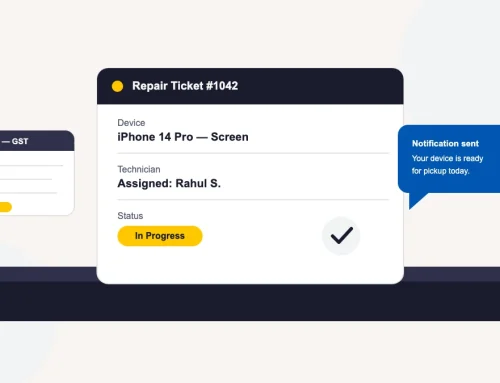
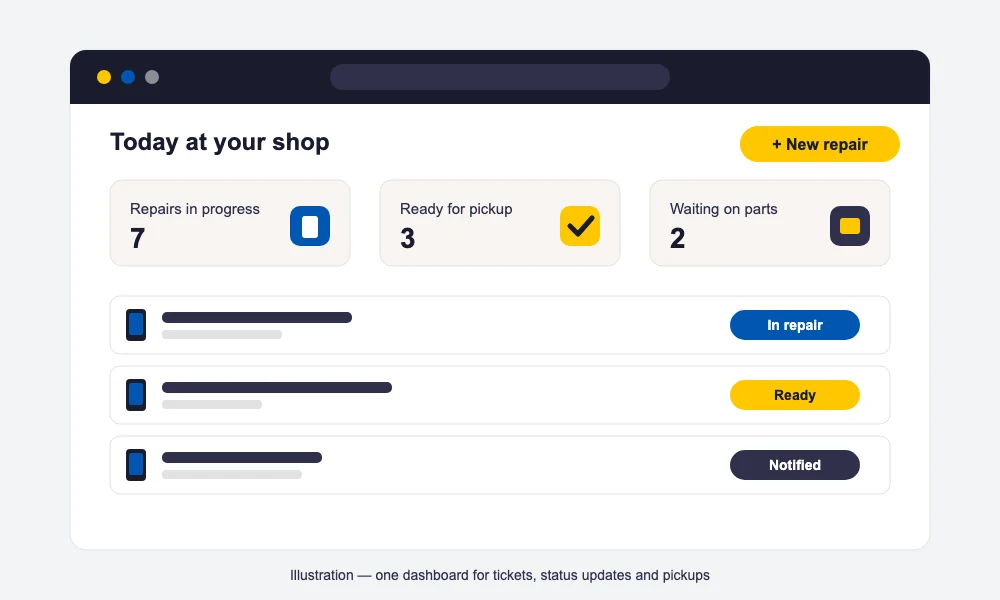
BytePhase is built specifically around this workflow: every device that comes in gets a repair ticket with the customer’s details, the reported issue, and device photos and a digital signature captured at intake so there’s no dispute later about condition. Parts come out of a barcode-tracked inventory tied directly to the ticket, so you always know what’s actually on the shelf. An estimate goes out for customer approval and converts to an invoice in one click once the work is done — no re-typing the same job twice. Customers get automatic WhatsApp, SMS, and email updates at each stage instead of calling to ask “is it ready yet,” and OTP-verified delivery confirms the right person picked up the right device before it leaves your counter.
It runs from a browser and from native Android and iOS apps with no per-device limit, so a technician at the bench and an owner checking in from home see the same live ticket queue. BytePhase is trusted by 2,000+ repair businesses across 32+ countries, and you can try the full system with a 15-day free trial before deciding whether it fits how your shop runs. For a broader look at what to expect from a repair-specific platform, see this mobile repair software guide.
KPIs to Track as You Grow
Once you’re a few months in, a handful of numbers will tell you far more about the health of the business than gut feel:
- Average ticket value — total repair revenue divided by number of tickets; watch whether it’s trending up as you add higher-value repairs.
- First-time fix rate — the share of devices that leave working correctly on the first attempt; a falling rate usually points at a training gap or a bad parts batch.
- Average turnaround time — from intake to ready-for-pickup; the single biggest driver of repeat business and reviews.
- Repeat-customer rate — what share of revenue comes from customers who’ve been in before; a healthy repair business leans on this more than constant new-customer acquisition.
- Parts cost as a percentage of revenue — creeping upward usually means a supplier problem or under-pricing, not just “parts got more expensive.”
- Inventory turnover — how quickly parts move off the shelf; slow-moving stock ties up cash you could be spending elsewhere.
Reviewing these monthly, rather than only when something feels off, is what turns a repair shop from a job into a business you can actually grow on purpose — see this practical goal-setting guide for how to turn these KPIs into targets for the year ahead.
That covers how to start a phone repair business end to end — niche, plan, licensing, skills, tools, location, pricing, marketing, software, and the numbers to track once you’re open.
Frequently Asked Questions
Starting costs typically run $5,000-$15,000 for a home-based or mail-in setup, and $20,000-$60,000+ for a storefront, covering licenses, tools, an initial parts inventory, repair-management software, and a few months of working capital. Location is the biggest swing factor — rent and buildout for a storefront dwarf every other line item on the list.
Yes, when parts and labor are priced with a healthy margin and turnaround time stays fast. Independent shops commonly see 40-60% gross margin on screen and battery repairs, with board-level and water-damage work pricing higher still. Profitability comes down to a high first-time fix rate, controlled parts cost, and a growing repeat-customer base rather than one-off walk-ins alone.
You’ll need the standard registration any small business needs — an LLC or sole proprietorship, an EIN, and usually a general business license from your city or county. Some states or cities add an electronics-repair or secondhand-dealer permit if you buy, sell, or trade used devices. Requirements vary, so verify with your state and local licensing office before opening.
Yes. Many independent repair businesses start home-based or mail-in to keep overhead low while they build a customer base, then move to a storefront once repair volume justifies the lease. Check your local zoning rules for home-based businesses and any limits on customer visits, since these vary by city and county.
You need one place to track repair tickets, parts inventory, and customer communication instead of a notebook or spreadsheet. BytePhase covers this with repair ticket management, barcode inventory, estimate-to-invoice conversion, and automatic WhatsApp, SMS, and email status updates, on web and native Android and iOS apps — with a 15-day free trial to test it against your workflow.